



May 1999 Regional Conference, Dayton Ohio
Report by Linda Eisenstein
illustrated with photos by ear (Elizabeth Arzberger)Friday May 21st, 1999
EARLY MORNING of the conference, during registration, a glorious surprise: a magnificent catered
brunch, with 2 kinds of quiche and Belgian waffles and other goodies, delicious and plentiful. It
gave us all the chance to mingle with the non-member attendees, mostly playwrights from the
Dayton-Yellow Springs area. (They weren't non-members for long -- just about everyone
joined ICWP during the conference.)
THERE WERE fewer playwrights from Columbus and Cincinnati than we'd expected, partly because
the Cincinnati playwrights had recently had a big 1-day gathering with speakers. The conference
facilities at Wright State University were professional, accessible, and visitor-friendly; we truly
appreciated the staff and the many posted signs that helped us find our way at every turn.
AND -- WONDERFUL lagniappe -- the main sessions were audiotaped by WSU conference staff with
major technical assistance from Elisabeth Arzberger (aka ear), our Austrian radio producer-
playwright-photographer. Tapes should be available from ICWP in the near future.
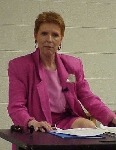
TRISH GAVE a welcome and a short history of ICWP before
"going virtual" (pre-ICWP-L mailing list)
-- going back to the first International Women Playwrights'
Conference in Buffalo, NY.
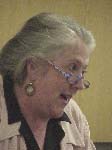
MARSHA HANNA -- Artistic Director of the Human Race Thatre, Dayton's smallish LORT -- talked
about their past new work development -- including a local playwrights' group (now defunct) and
a well-recieved commissioned work based on community oral histories -- and the depressing fact
of how difficult it is for her to program full productions of new plays by unknown writers.
In fact, she said almost all newish plays by less-than-household name playwrights are hardest for her to
sell to her subscribers. She tends to share scripts with other theatres their size -- i.e., the Phoenix
in Indianapolis & Ensemble Theatre of Cincinnati. her recommendation? Get involved with your
theatres! She (like many other Artistic Directors) is much more likely to program or commission a
work froma writer she already knows & respects.
We all had lunch together in the Wright State U. cafeteria -- lots more mingling and round-the-table talk.
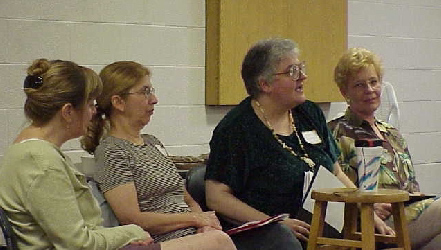
Tami Canaday (Denver), Sandra Perlman (Ohio), Linda Eisenstein (Ohio), & Hilda Vleugels (Belgium)
brunch, with 2 kinds of quiche and Belgian waffles and other goodies, delicious and plentiful. It
gave us all the chance to mingle with the non-member attendees, mostly playwrights from the
Dayton-Yellow Springs area. (They weren't non-members for long -- just about everyone
joined ICWP during the conference.)
THERE WERE fewer playwrights from Columbus and Cincinnati than we'd expected, partly because
the Cincinnati playwrights had recently had a big 1-day gathering with speakers. The conference
facilities at Wright State University were professional, accessible, and visitor-friendly; we truly
appreciated the staff and the many posted signs that helped us find our way at every turn.
AND -- WONDERFUL lagniappe -- the main sessions were audiotaped by WSU conference staff with
major technical assistance from Elisabeth Arzberger (aka ear), our Austrian radio producer-
playwright-photographer. Tapes should be available from ICWP in the near future.
Welcome: Trish Sandberg, ICWP Director of Outreach
TRISH GAVE a welcome and a short history of ICWP before
"going virtual" (pre-ICWP-L mailing list)
-- going back to the first International Women Playwrights'
Conference in Buffalo, NY.
Keynote Address: Marsha Hanna
MARSHA HANNA -- Artistic Director of the Human Race Thatre, Dayton's smallish LORT -- talked
about their past new work development -- including a local playwrights' group (now defunct) and
a well-recieved commissioned work based on community oral histories -- and the depressing fact
of how difficult it is for her to program full productions of new plays by unknown writers.
In fact, she said almost all newish plays by less-than-household name playwrights are hardest for her to
sell to her subscribers. She tends to share scripts with other theatres their size -- i.e., the Phoenix
in Indianapolis & Ensemble Theatre of Cincinnati. her recommendation? Get involved with your
theatres! She (like many other Artistic Directors) is much more likely to program or commission a
work froma writer she already knows & respects.
We all had lunch together in the Wright State U. cafeteria -- lots more mingling and round-the-table talk.
Panel Discussion:
PLAYWRIGHT EMPOWERMENT: Think Global, Act LocalTami Canaday (Denver), Sandra Perlman (Ohio), Linda Eisenstein (Ohio), & Hilda Vleugels (Belgium)
| We jokingly subtitled it "Alternatives to Blind Submission". Each of us
spoke about things we've learned about developing plays in our
respective regions.We all continued to riff off Marsha's keynote theme
about "making partnerships" with area theatres and professionals rather
than seeing yourself as a solo act whose primary job was to address
envelopes with completed scripts & SASE's: Hilda -- who is one of only 3 women playwrights active in Belgium -- and by far the most prolific and produced -- talked about going to area theatres as an audience member, making sure she met the director(s), becoming a "face" before she sent a script. In Belgium, unlike the US, plays are first sent to editors, not directly to theatres. But she noted how many things she'd learned about other marketing/development techniques from her ICWP sisters, including "staged readings". She then described a successful reading event of play excerpts she talked her Flemish Playwrights' Association into putting together for Belgian theatre producers -- which made folks much more interested in looking at new scripts. Sandra - who was instrumental in the early days of the Ohio Theatre Alliance's play workshops in the 80's, and also an organizer of the First International Women Playwright Conference -- talked about the ups and downs of play development during her 20+ year career. She also shared how these days as a member of the Cleveland Play House Playwrights' Unit she listens more to what good actors say about her work than to dramaturgical talkbacks. Tami talked about Chameleon Stage in Denver, their small (5 member) playwright-based production company, how they operate -- organizing readings, some productions, continuing meetings where they comment on member scripts -- and ways they've gotten publicity. I (Linda) covered some of my 12-year history doing play development at Cleveland Public Theatre -- some things about marketing new plays -- how to position yourself as a writer as part of your area "theatre ecosystem". Also, how my own experience leads me to believe that it's frequently more productive to get your plays to active, working directors -- who can then get them into the theatre(s) they work in, captaining a production they will tirelessly advocate -- than to go via the theatres' literary staffs, who can only recommend/reject. |
3 well-acted readings of play excerpts
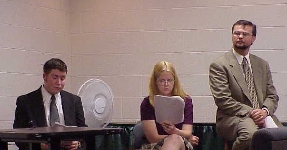 Trish Sandberg - "Nightfall Vienna" a look at the Nazi push into Austria and its effects on ordinary citizens. | 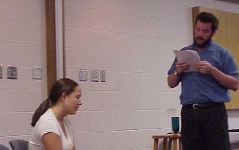 Diana Barth - "Bound Together" the unraveling of an abusive relationship. |
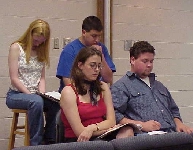 Carole Clement - "Babes in America"
a satirical comedy about our lightning-paced life at the millennium. | NOTE: There was no "curating" of member scripts. If an attending member sent in a 10-15 minute excerpt to the conference, it was staged. It's a testament to the talent of our members that the work was all so intriguing and so different. Trish circulated copies of the excerpts to her student directors, and the first director who begged to work on a script got to direct it. A fine system! They were all done with skill and energy by the mostly student actors. Dinner Break -- We separated into a few different groups, to go to restaurants nearby. |